Same tasks, same rules, side-by-side result.
Benchmark as a Service
Know which system to trust.
Give us the candidates and the work that matters. We run them, compare the outcomes, and return the evidence you need to choose, ship, repair, or hold.
Useful for model selection, agent qualification, harness comparison, and release gates.
Use Cases
Start with the decision.
Benchmark as a Service is for moments when a claim is too important to accept from a demo.
Completion, policy fit, review burden, and evidence quality.
Direct run versus governed run, with cost and failure differences visible.
Repeat the workload and catch regressions before release.
What You Get
The answer and the evidence.
The report names the recommendation, the tradeoffs, the failures, and the limits. Enough to decide without pretending the benchmark proved more than it did.
- Answer
- Choose, ship, repair, hold, or rerun.
- Comparison
- Outcome, cost, latency, review burden, and recovery.
- Failures
- Blocked, timed out, invalid, unresolved, and weak-evidence cases.
- Boundary
- What the result supports, and what it does not support.
Example Readout
The winner depends on the decision.
One system solves more. Another costs less and leaves a stronger trail. The benchmark makes that choice visible.
| System | Resolved | Evidence complete | Median cost/task | Review/task | Recovery success |
|---|---|---|---|---|---|
| Agent A lower cost, stronger evidence trail |
76% | 94% | $0.82 | 0.7 min | 71% |
| Agent B higher solve rate, weaker evidence trail |
81% | 61% | $2.41 | 2.6 min | 43% |
Boundary
A benchmark is useful only if it changes a decision.
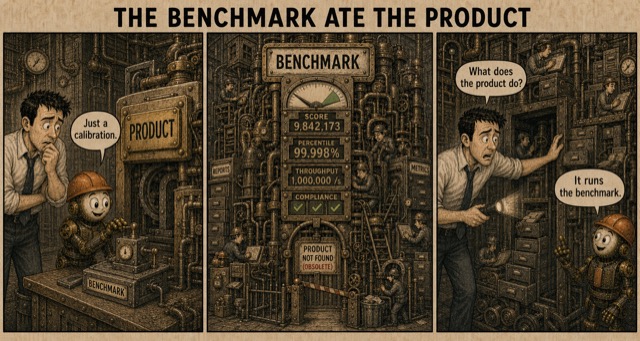
A benchmark becomes theater when it chases a score without preserving the workload, cost, failures, or evidence trail. Standing Framework keeps the result connected to the system that performed the work and the decision it is meant to inform.
It does not claim public leaderboard authority, customer validation, production API availability, product-market fit, or general model superiority.
Access
Inspect before you run.
Benchmark work is requested and scoped with an owner. The public API exposes evidence and boundaries, not a self-serve benchmark runner.
Next Step
Bring the system and the work.
Use Benchmark as a Service before a claim turns into an operating commitment.