1. Name the blocked work.
The Console does not hide behind a green status. It shows the line, blocker, next Controller move, and last human decision.
Switchboard / Control Console
Make every consequential AI-agent run reviewable.
Switchboard is the control surface for deciding what should happen next after agent work: artifact, verification, uncertainty, approval, cost, and the next human move in one durable record.
Control plane, translated
The value is not another command center. It is the moment a human can tell whether important AI work is safe to continue, needs revision, or should stop.
When an agent run reaches a decision point, Switchboard keeps the work legible: what changed, what was checked, what remains uncertain, who has authority, and what should happen next. It is built for reviewers who need continuity without replaying an entire session.
Current product surface
The Console makes the blocked approval visible first: the work is paused, the uncertainty is named, and the Controller can see why the decision matters.
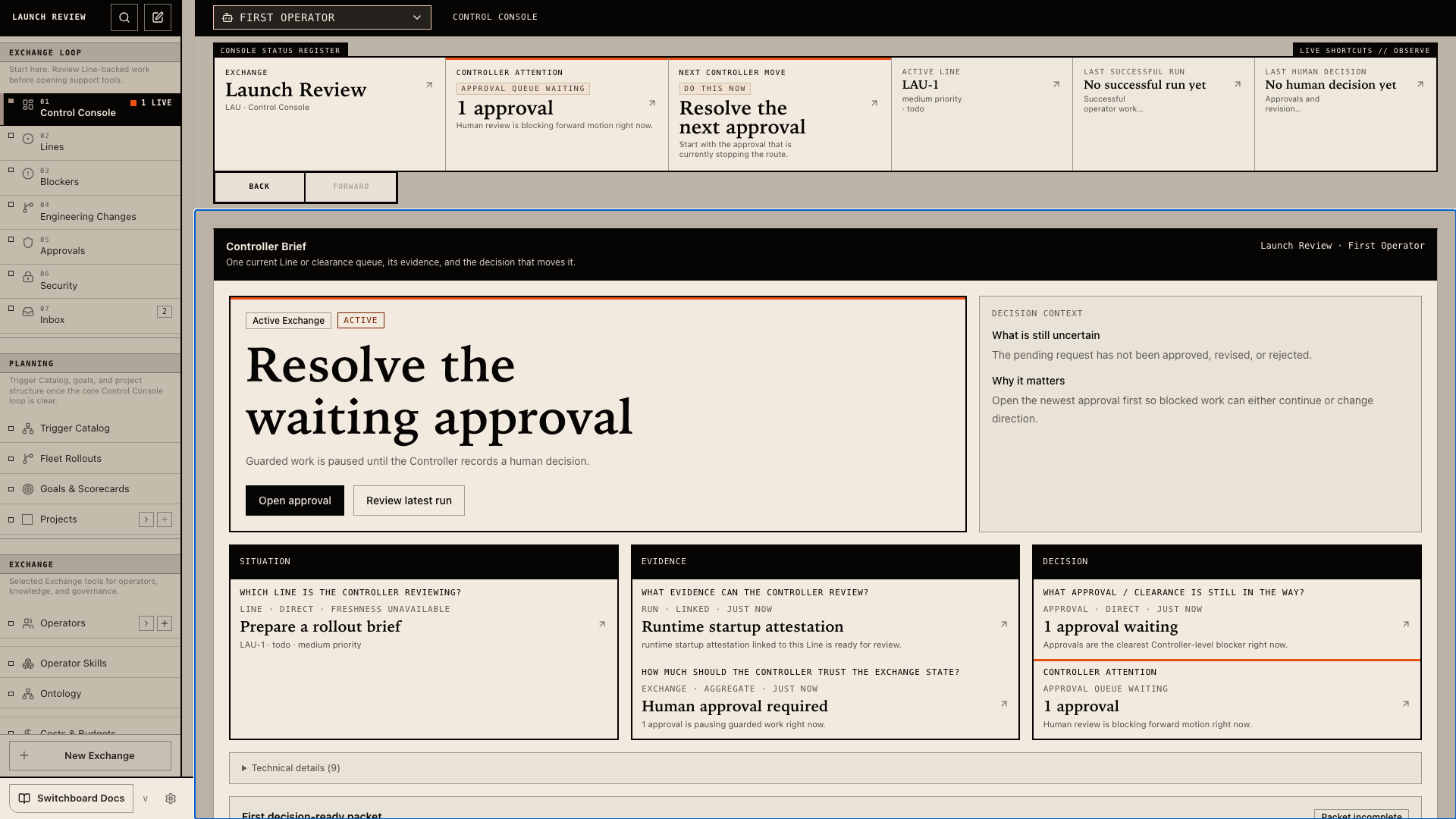
Evidence to decision
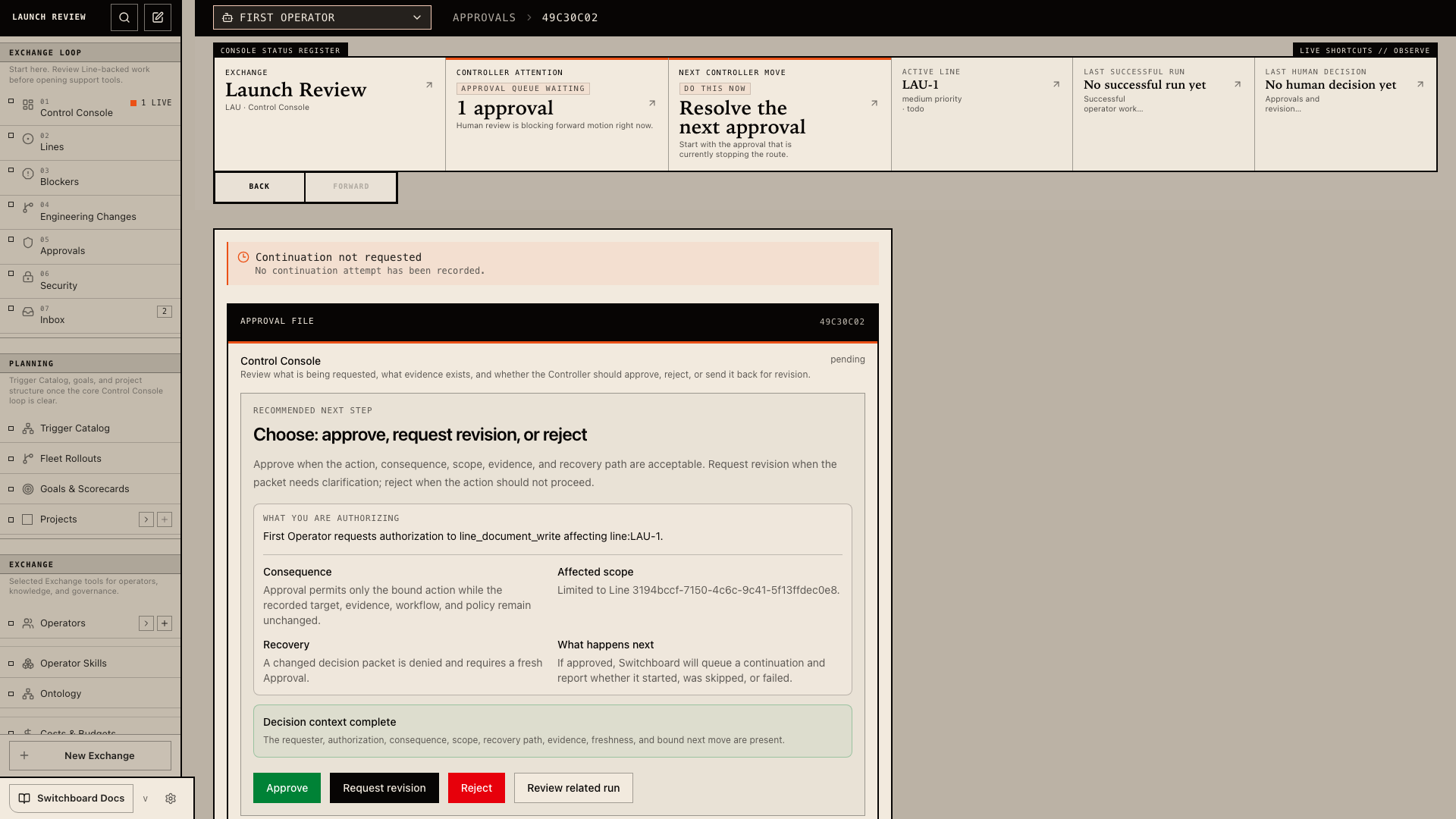
Switchboard keeps the review path specific: what is being authorized, what evidence exists, what scope is affected, and what happens next.
The Console does not hide behind a green status. It shows the line, blocker, next Controller move, and last human decision.
Run summaries, fact checks, document review, and related outputs sit inside the record instead of being reconstructed from a transcript.
The human choice is bounded: approve, request revision, reject, or review related work before continuing.
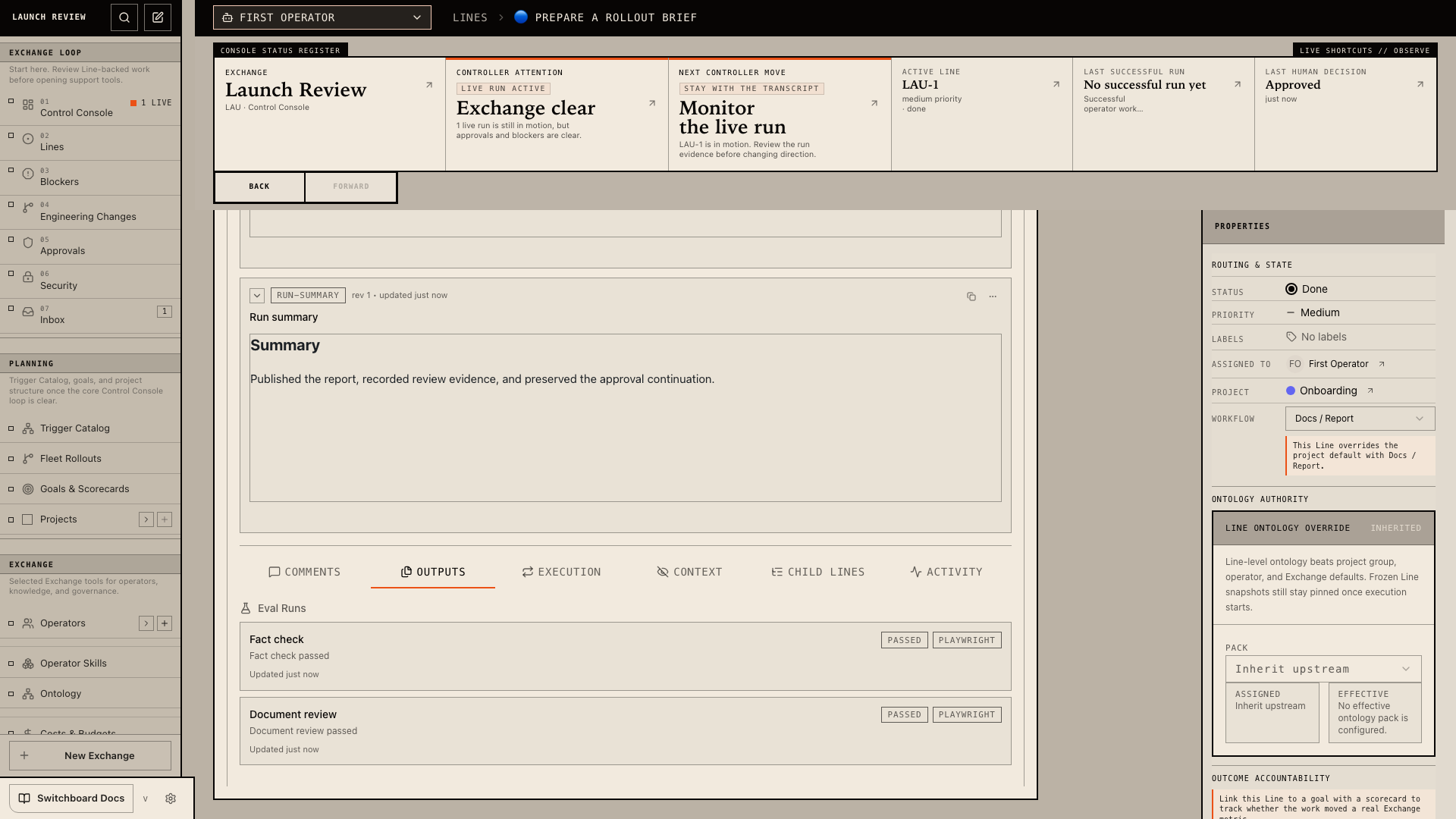
Proof from the work
The Control Console is the visible face of a governed-work benchmark program: registered trials, proof rows, validity probes, runtime-invariant conversions, and repository gates.
The point is not a leaderboard claim. The point is that Switchboard has repeatedly been used to preserve denominators, surface missing evidence, and bind human decisions to current proof.
Seven independently executed 240-trial campaigns across the frozen authenticated Codex catalog, with two explicit non-runs retained.
From a 4,189-row benchmark evidence packet across 9 benchmark runs, including 13 missing-evidence rows kept visible.
Baseline and candidate arms finished 115/120 and 118/120, clearing the preregistered non-inferiority margin with zero hard-governance failures.
Blocked lifecycle, line acceptance, materialization, and AgentDojo replay rows converted benchmark evidence into runtime controls.
Repo proof closes the loop: benchmark procedure proof, real-run intake, Terminal-Bench calibration, scenario smoke, operator-gate E2E, shipability, and pinned merge decisions tie the numbers back to working Switchboard code. These figures are product and benchmark proof, not claims of customer adoption, validated ICP, product-market fit, or public benchmark superiority.
Approval queue
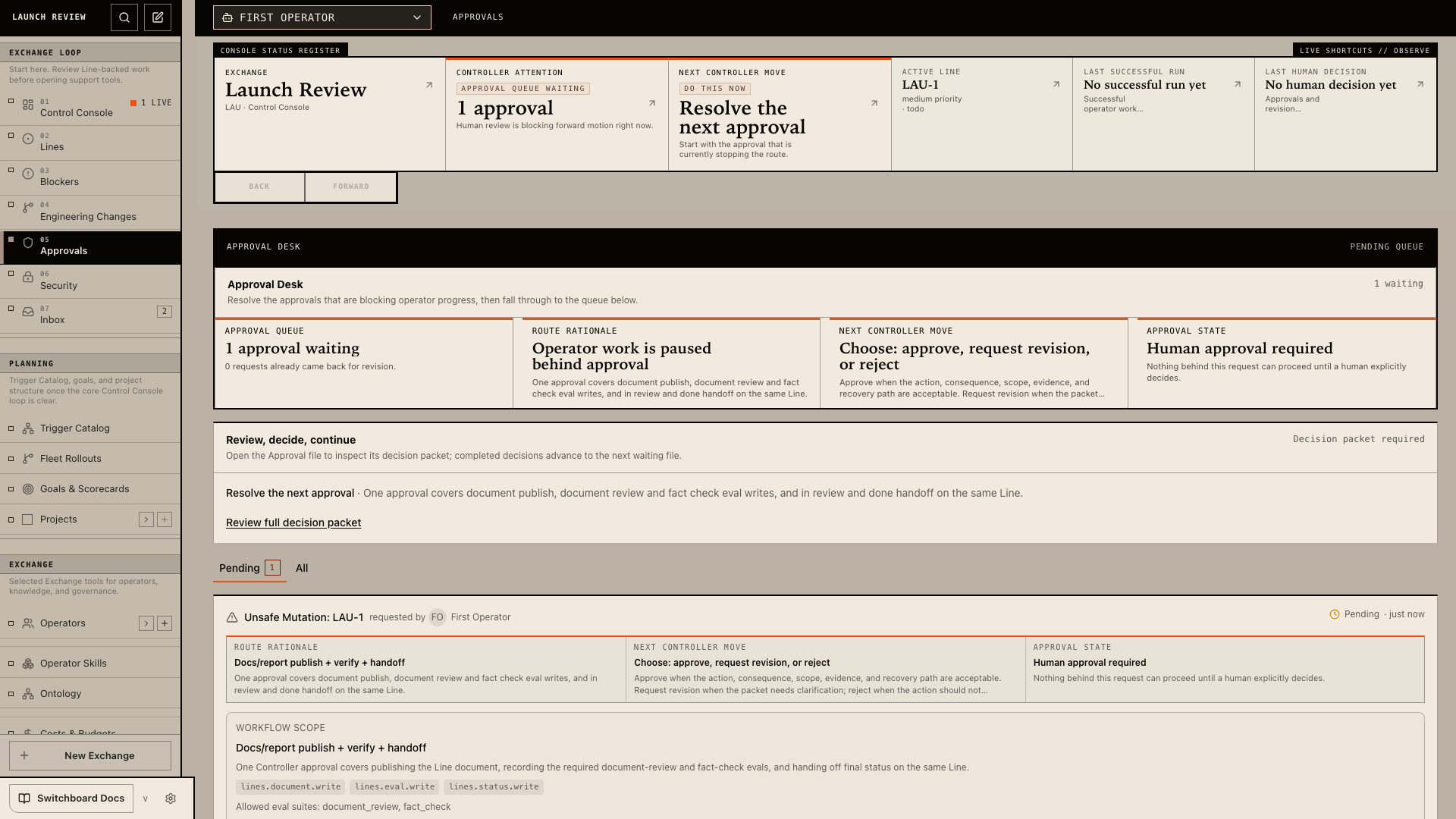
The test is simple: can a qualified reviewer understand what happened, what is uncertain, and what they should do next without replaying the entire agent session?